

What is the FEMA 50 percent rule in Florida?
The FEMA 50 percent rule says that if the cost to repair a damaged house equals or exceeds 50 percent of the building's market value before the damage, and the house is in a high-risk flood zone, it is "substantially damaged" and must be brought up to current flood rules. Usually that means elevating it. Land value doesn't count. Your local building official or floodplain manager makes the call, not FEMA.
The same test applies to big remodels and additions (substantial improvement). This page uses Charlotte County as the worked example. In Sarasota, Bradenton and Tampa Bay, your own county or city decides, so call its building department.
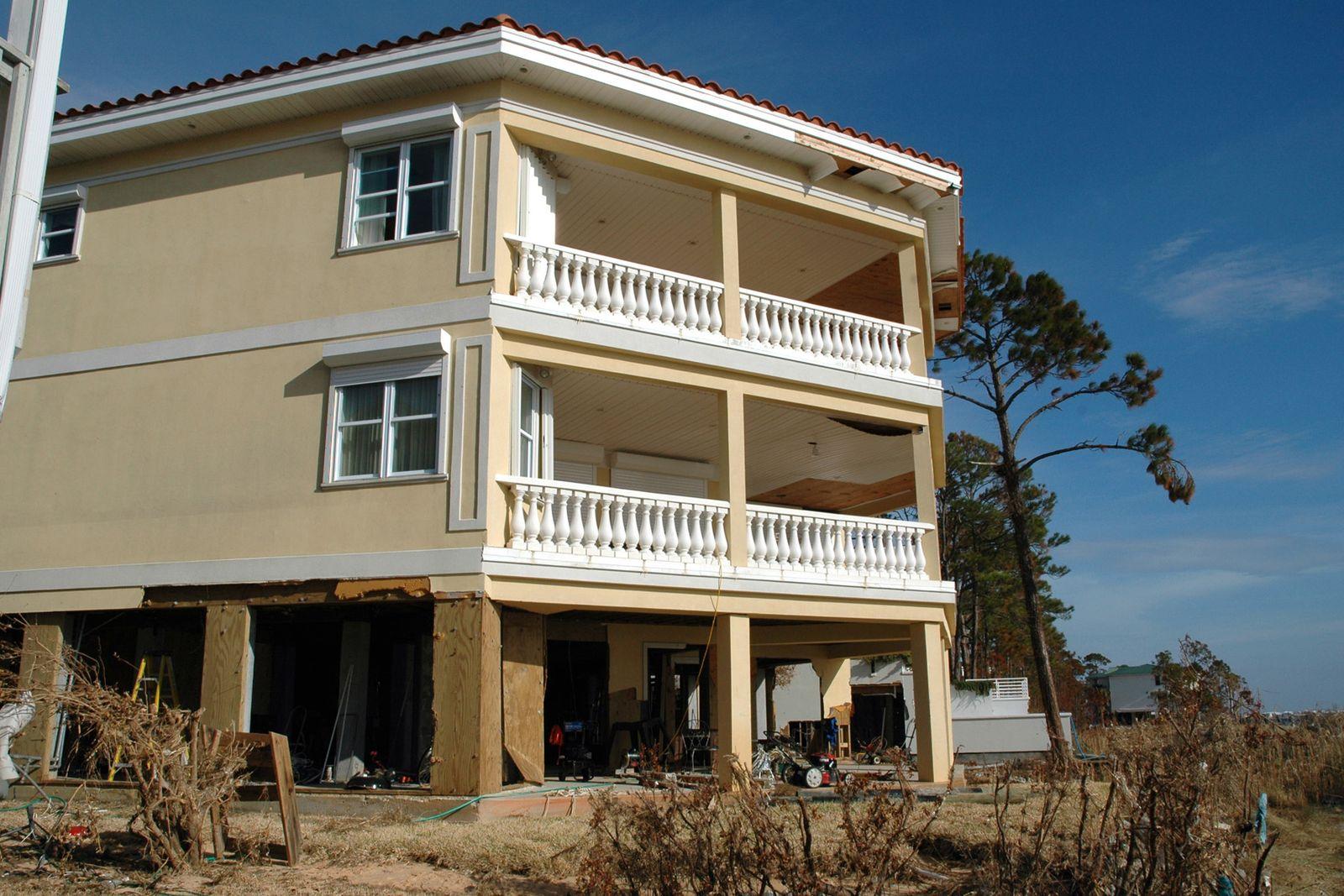
Who decides if my house is substantially damaged?
Your community does. A FEMA fact sheet for Florida homeowners says FEMA does not make substantial damage determinations; a community's building official or floodplain manager does. The Florida Division of Emergency Management agrees.
In Charlotte County, that's Community Development (Building Construction), 18500 Murdock Circle, Port Charlotte, (941) 743-1200. Punta Gorda is its own city, so owners inside city limits should check with the city. After a storm, the county does damage assessments and posts placards telling owners when a permit is needed, even if a contractor says otherwise. Placard questions go to (941) 743-1201.
The rule covers buildings in a FEMA high-risk flood zone that don't meet today's elevation requirements. Look up your flood zone on the county's 50% FEMA Rule page.
How is the 50 percent calculated?
It's two numbers: the cost of the work divided by the market value of the building (not the land).
The building's value. Charlotte County uses an approximate market value of the structure from the Property Appraiser. It isn't on the appraiser's website, so request it at RP@CharlotteCountyFL.gov or (941) 743-1498. If you disagree, you can submit an appraisal from a Florida-licensed appraiser that follows FEMA's guidelines, and a private appraisal from the past 12 months can be used.
The cost of the work. All materials and labor to put the house back the way it was, such as drywall, flooring, cabinets and paint, on an estimate signed by a licensed contractor (or documented by you as owner-builder). Volunteer labor still counts. Permits, surveys, pools, screens, sheds and fences are left out.
The county's example: with a building value of $250,000, work of $125,000 or more crosses the line. Two things catch people off guard:
- Repairs add up. The county counts all permits tied to one storm, open or closed. Splitting a repair into phases doesn't get around it.
- Some homes are exempt. If the lowest floor and the equipment are already at the required height (one foot above the base flood elevation), the house is treated as compliant. An elevation certificate shows it.
What happens if my house is substantially damaged?
It has to be brought into compliance with the flood rules and the Florida Building Code. FEMA lists the options for a home as elevating it to the height your local officials set, moving it out of the floodplain, or demolishing it.
In Charlotte County, you submit an elevation certificate. If the lowest floor is below the base flood elevation plus 1 foot, the house must be raised to at least that level, along with the heating and cooling, electrical equipment, bathrooms and laundry. Below it, only parking, access and limited storage are allowed. Plans must show how it will be elevated, certified by an engineer or architect in a V zone or Coastal A zone.
Do you need a permit? Yes. FEMA says repairing a structure in a floodplain requires a permit, and Charlotte County says to apply before starting any repair in a high-risk flood zone. The 50 percent review happens with the permit application.
If you think the numbers are wrong, you can submit a private appraisal of the building. For any other review or appeal, ask Community Development at (941) 743-1201.
Does flood insurance pay to elevate?
It can help. A National Flood Insurance Program (NFIP) policy includes Increased Cost of Compliance (ICC) coverage. According to FloodSmart, the NFIP's official site, qualifying policyholders can get up to $30,000 to elevate, relocate or demolish a house.
To qualify, the building must be in a Special Flood Hazard Area and your community must determine it was substantially (or repeatedly) damaged by flooding. The ICC claim is separate from your building claim, and the two together can't go over the building coverage limit. ICC pays toward the compliance work itself, so talk to your insurance agent before you decide anything.
Your options with a substantially damaged house
| Option | What it takes | Often a fit when |
|---|---|---|
| Repair to code | Repairs under 50 percent, or a house already at the required height | The damage is lighter than it looks |
| Elevate and repair | Elevation certificate, plans, permits and a contractor (ICC may help if you have a flood policy) | You want to stay and can cover the cost |
| Demolish and rebuild | Demolition and a new house built to current flood rules | The house is old or the land is the real value |
| List with an agent | Repairs or disclosure, time on the market, commissions and closing costs | The house is in good shape and you have time |
| Sell as-is to Big Buck Offers | Tell us the address and what the county said | You don't want to take on elevation or a rebuild |
To be fair about it: if the house is in good shape and you have time, listing with an agent can bring a higher price. Compare what you'd actually walk away with after repairs, commissions, closing costs and months of payments. When you sell to us, there are no repairs, no fees and no commissions, and we pay the closing costs.
When you sell as-is, the next owner takes on the decision to elevate, rebuild or demolish. Florida sellers also fill out a flood disclosure, and an as-is sale doesn't skip it. Our Port Charlotte page explains the flood disclosure.
If the county posted an unsafe notice, read what a condemned house notice means. Behind on taxes or the mortgage too? See our Charlotte County homeowner help page, or selling a house in Sarasota.
How selling to us works
- Tell us about the house. Use the form on this page or call 1-844-348-9268.
- Get a cash offer, usually the same day we have the property details.
- Pick your closing date, as soon as 7 days or on the date you choose.
You can leave the contents behind. Or just ask us for an offer.
FAQ
What is the FEMA 50 percent rule?
If repairs to a building in a high-risk flood zone cost 50 percent or more of its market value (land not counted), it must meet current flood rules, usually by elevating it.
How do you calculate the FEMA 50 percent rule?
Divide the full cost of the repairs (materials and labor) by the building's market value before the damage. In Charlotte County, the value comes from the Property Appraiser or a private appraisal you submit.
Are there exceptions to the 50 percent rule?
It only applies in FEMA high-risk flood zones. In Charlotte County, a house already at the required height is treated as compliant, with an elevation certificate to prove it.
Can I use my own appraisal for the 50 percent rule?
In Charlotte County, yes. If you disagree with the Property Appraiser's value, you can submit an appraisal from a Florida-licensed appraiser that follows FEMA's guidelines.
Can I sell a house that's substantially damaged?
Yes, as-is. The next owner decides whether to elevate, rebuild or demolish. Fill out Florida's flood disclosure honestly and tell the buyer what the county determined.
This page is general information about how these rules can work. It isn't legal, insurance, tax or financial advice, and Big Buck Offers isn't a law firm, an attorney, an insurance agent, a lender or a financial advisor. Reading it doesn't create an attorney-client or advisory relationship with anyone. Every house and every county is different, and rules change, so please confirm the details for your house with your county building department, your insurance agent or your own attorney before you decide. We're glad to answer questions.