

Can you sell a house with sinkhole damage in Florida?
Yes. You can sell a Florida house with sinkhole activity, a past sinkhole claim or a sinkhole repair, either repaired or as-is. What you can't do is keep it quiet: under Florida Statutes section 627.7073, if an insurer paid a sinkhole claim on the property, the seller must tell the buyer before closing that a claim was paid and whether the full amount was used to repair the sinkhole damage.
After that, you have three paths: repair and list, list as-is with full disclosure, or ask us for a cash offer and compare.
Where sinkholes are common. The Florida Geological Survey says the whole state sits on carbonate rock, so a sinkhole can form almost anywhere, with the risk much higher where limestone is near the surface. A 2010 Florida Senate report called Hernando, Pasco and Hillsborough the "sinkhole alley" counties and found over 66 percent of the sinkhole claims it studied came from those three. The Survey keeps a statewide map of reported subsidence incidents, but it warns most reports were never field-checked, so a dot near you doesn't prove anything about your house.
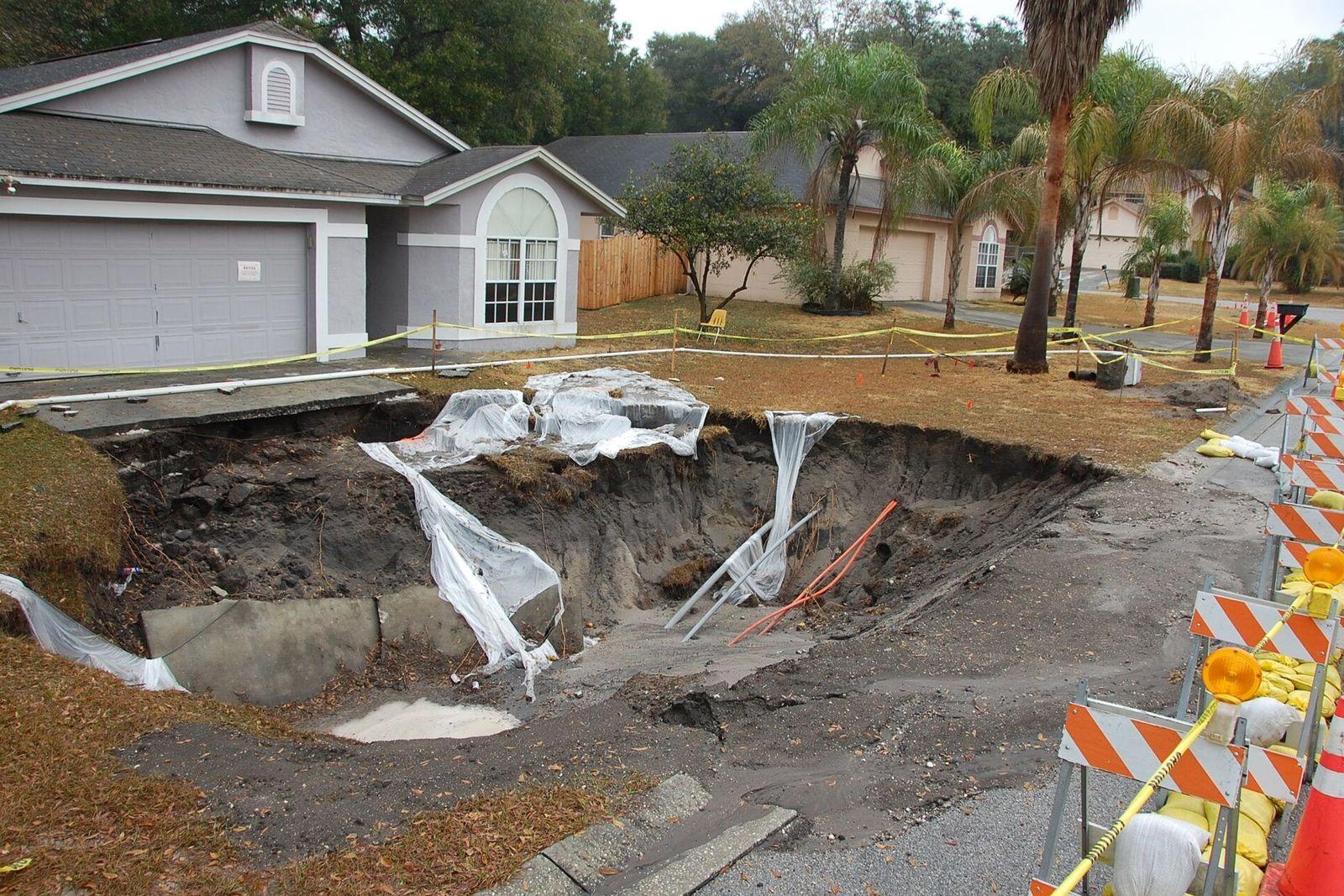
Does homeowners insurance cover sinkholes in Florida?
Florida law splits this into two kinds of coverage.
Catastrophic ground cover collapse. Section 627.706 says every insurer writing property insurance in Florida must cover it. But all four of these have to happen: the ground collapses abruptly, there's a depression you can see with the naked eye, the building (including the foundation) is structurally damaged, and a government agency condemns the house and orders it vacated. Cracks and slow settling alone don't meet that test.
Sinkhole loss coverage. This covers structural damage from sinkhole activity short of a collapse. It's optional: insurers must offer it for an extra premium, may require an inspection before writing it, and may use a sinkhole deductible of 1, 2, 5 or 10 percent of the dwelling limit. Citizens Property Insurance offers it as an optional endorsement on its homeowners and dwelling policies and requires a sinkhole inspection for some properties.
If you have a claim. Notice must reach the insurer within 2 years after you knew or reasonably should have known about the loss. Under section 627.707, the insurer inspects, hires a professional engineer or geologist to test when the damage looks sinkhole-related, and, if the loss is confirmed, pays for stabilization and foundation repairs that follow the engineer's recommendations. You generally have 90 days to sign a repair contract, and payments are made as the work proceeds. If you and the insurer disagree, either side can ask for neutral evaluation through the Florida Department of Financial Services (section 627.7074). It's nonbinding, and the insurer pays the cost.
Call your insurance agent to confirm which coverage your policy has. Rules and company guidelines change.
Do you have to disclose a sinkhole when you sell?
In most cases, yes, in two ways.
The statute. Section 627.7073 says a seller of property where a sinkhole claim was made and paid must disclose to the buyer, before closing, that a claim was paid and whether or not the full amount was used to repair the damage. On a paid claim, the insurer also files the engineering report and any stabilization certification with the county clerk of court, where it's recorded. The statute says that recording doesn't create a lien or a title defect, but a buyer's agent or title company can find it.
The general rule. In Johnson v. Davis, 480 So. 2d 625 (Fla. 1985), the Florida Supreme Court held that a home seller who knows of facts materially affecting the value that aren't readily observable and aren't known to the buyer must disclose them. Known sinkhole activity, even with no claim filed, can fit that description.
Put it in writing, and hand over the engineering report, the repair contract and any completion certification. If you're unsure what to say, talk to a Florida real estate attorney.
Does sinkhole repair hurt resale?
It can make the house harder to sell, and the paperwork decides a lot. Buyers, lenders and insurers all want to know what the engineer recommended and whether that's what was done.
Grouting vs underpinning. A Citizens explainer says grouting pumps cement grout (or an expanding resin) into the ground to fill voids, seal the limestone and firm up the soil, while underpinning drives steel piers to relevel or stabilize the foundation. Citizens notes that underpinning by itself doesn't repair the sinkhole that caused the damage. That's why a house where the full recommended repair was done and certified usually shows better than one that was only partly fixed.
Cost. Repair is expensive, and your number depends on the house and the engineer's plan. The 2010 Senate report cited geologists' and engineers' estimates of about $35,000 to $45,000 for underpinning and $75,000 to $90,000 for grouting, for homes worth $150,000 to $300,000 at the time. Treat those as old reference points and get current bids.
If the house is in our markets around Tampa, Lakeland, Orlando or Kissimmee, we look at sinkhole houses with the reports in hand, repaired or not.
Your options for a sinkhole house
| Option | What it takes | Often a fit when |
|---|---|---|
| Finish the repair, then list | Engineer's plan, grouting or underpinning, certification, then time on the market, commissions and closing costs | The claim paid for the full repair and you have time |
| List as-is with full disclosure | The engineering report and claim history up front, a price that reflects it, and a buyer who can get insurance | The repair is done or the damage is minor and your area is in demand |
| Sell as-is to another cash buyer | Disclosure and a lower price than a repaired house | You want speed and don't want to manage repairs |
| Sell as-is to Big Buck Offers | Tell us the address and share what you have (claim, report, repairs) | You want a cash offer to compare against listing |
To be fair about it: if the house was fully repaired and certified and you have time, listing with an agent can bring a higher price. Compare what you'd actually walk away with after commissions, closing costs, repair requests after inspections and months of payments while it sits. When you sell to us, there are no repairs, no fees and no commissions, and we pay the closing costs.
More help: what to do when you can't sell your house, or our pages on polybutylene pipes and the FEMA 50 percent rule. We also buy in Port Charlotte, Sarasota, Bradenton and Jacksonville.
How selling to us works
- Tell us about the house. Use the form on this page or call 1-844-348-9268.
- Get a cash offer, usually the same day we have the property details.
- Pick your closing date, as soon as 7 days or on the date you choose.
We buy as-is, so you don't have to finish a repair first.
FAQ
Do I have to disclose a sinkhole repair in Florida?
If an insurer paid a sinkhole claim, Florida law says you must tell the buyer before closing that a claim was paid and whether the full amount went to repairs. Florida case law also requires disclosing known hidden defects that affect value.
Does homeowners insurance cover sinkholes in Florida?
Every policy must cover catastrophic ground cover collapse, which needs an abrupt collapse, a visible hole, structural damage and a government order to vacate. Other sinkhole damage is covered only if you bought optional sinkhole loss coverage.
Can you get a mortgage on a sinkhole house?
The CFPB says lenders generally require homeowners insurance, so it depends on whether the buyer can insure the house. A completed, certified repair with the engineering report usually makes that easier. Ask a lender and an insurance agent early.
What is sinkhole alley in Florida?
A 2010 Florida Senate report used the name for Hernando, Pasco and Hillsborough counties, where most sinkhole insurance claims were filed. Sinkholes can form elsewhere in Florida too.
Do you buy sinkhole houses?
Yes. We buy as-is in our Florida markets, repaired or not, with no commissions, and we pay the closing costs.
This page is general information, not legal or insurance advice.